Why Your Resort Needs Its Own Booking Website, Even If You Have Facebook
Already taking bookings on Facebook Messenger? Here's why a booking website helps your resort get more direct bookings without leaving Facebook, Agoda or Booking.com.
Most small resorts in the Philippines start with Facebook.
You post pictures of your rooms, share promotional rates, upload videos of your swimming pool, and wait for inquiries.
When someone wants to book, they send a message:
"Hi! Available pa po ba this weekend?"
You check your calendar, reply with the rates, send room photos, and wait for confirmation.
It works. Many resorts in Bantayan, Boracay, Siargao, Bohol and other tourist destinations operate this way.
But as your property gets busier, relying entirely on Messenger becomes increasingly difficult.
Guests want to see your rooms, compare prices, check availability and make reservations without waiting for someone to reply.
That's where having your own booking website makes a difference.
1. Your Facebook page is not your booking website
Facebook is excellent for marketing your property.
It's where you share promotions, interact with potential guests, publish customer reviews and showcase what makes your resort special.
However, Facebook wasn't designed specifically for managing room reservations.
Think about what happens when someone wants to book:
- They visit your Facebook page.
- They browse your photos.
- They send a message asking about availability.
- They wait for someone to respond.
- They ask about rates, room capacity and payment arrangements.
- They wait again while you check your calendar.
That's a lot of steps before someone can even make a reservation.
Now imagine a guest discovering your resort at 11 PM.
They like your property, want to book for next weekend, but nobody is available to answer their message.
They might wait until morning. Or they might simply find another resort that makes booking easier.
A booking website gives guests another way to proceed, even when your staff aren't available to respond immediately.
2. Guests want to see available rooms before contacting you
One of the biggest inconveniences of booking through Messenger is having to ask about everything.
Is the family room available?
How much is the villa?
Can we accommodate 10 people?
What dates are still open?
These questions are normal, but answering them individually takes time.
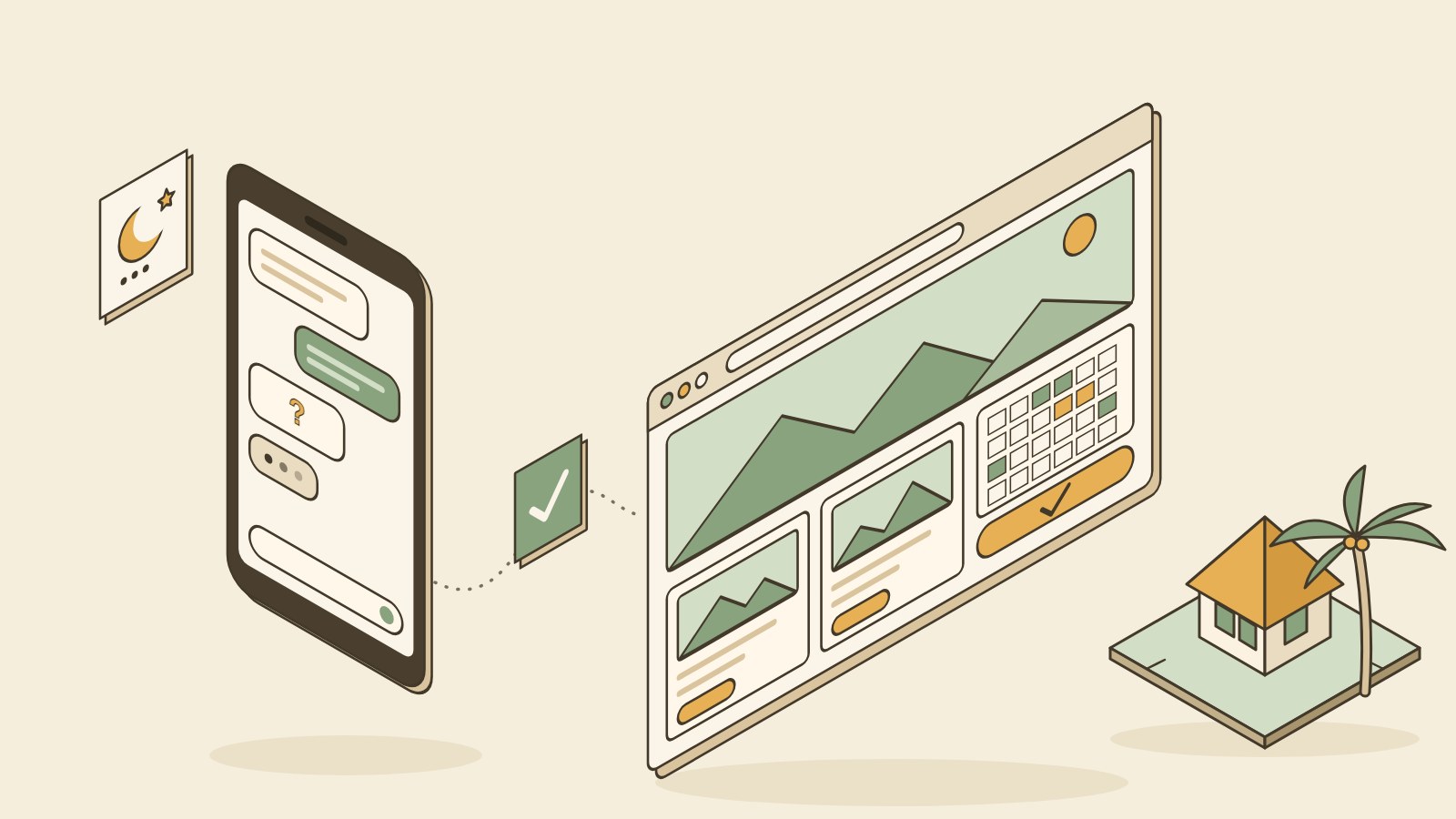
A dedicated booking website can organize this information in one place.
Guests should be able to:
- Browse your available room types.
- See room photos and descriptions.
- Check room rates.
- Select their preferred dates.
- Submit their reservation online.
Instead of answering the same questions repeatedly, you can direct potential guests to one link containing the information they need.
Your staff can spend less time answering basic inquiries and more time handling confirmed reservations and actual guests.
3. A professional website gives guests another reason to trust your property
Imagine two situations.
Property A: a Facebook page with several photos, a phone number and a Messenger button.
Property B: a Facebook page with photos, customer reviews, contact information and a dedicated booking website showing its rooms, rates and reservation options.
Both properties might offer exactly the same accommodation.
However, Property B gives potential guests another place to verify the business and understand what they're booking.
This matters particularly for travelers who haven't visited your property before.
A dedicated website gives you more control over how your property is presented.
You can showcase your best rooms, highlight your amenities, explain your policies and provide clear booking instructions.
It also gives guests a direct online destination associated with your property name.
You don't need an expensive corporate website to achieve this. What matters is that guests can easily find the information they need and understand how to make a reservation.
4. You can get direct bookings without leaving Agoda or Booking.com
Some resort owners assume that having their own booking website means they should stop accepting reservations through online travel agencies (OTAs).
That's not the case.
Platforms like Agoda, Booking.com and Airbnb serve an important purpose: they help travelers discover properties they might not have encountered otherwise.
However, not every guest needs to book through an OTA.
Consider these situations:
- A previous guest wants to return for another vacation.
- Someone discovers your resort through Facebook.
- A friend recommends your property to their family.
- A traveler searches your resort's name on Google.
- Someone sees your promotional post and wants to reserve immediately.
These guests may already know which property they want.
They don't necessarily need an OTA to make their decision.
If you have your own booking website, you can give them a direct reservation option.
You can continue using Agoda and Booking.com for discovery while building a separate channel for guests who already know your property.
If you want your OTA availability to synchronize automatically with your direct bookings, you can also consider a channel manager.
For a deeper look at the financial side, read our guide: Direct Bookings vs OTA Bookings: What Commissions Really Cost a Small Philippine Guesthouse.
5. You don't need to hire a developer to get a booking website
One reason small property owners delay building a website is the perceived cost.
Hiring someone to build a custom website can involve:
- Website development fees.
- Domain registration.
- Web hosting.
- Website maintenance.
- Additional costs when you need changes.
For a small resort with 3–15 rooms, building an expensive custom website might not be necessary.
What you actually need is a website designed around your property's booking process.
Look for a solution that already includes:
- Room listings and photos.
- Rates and availability.
- An online reservation process.
- Mobile-friendly pages.
- A dedicated web address.
- A way to manage incoming reservations.
You should be able to update your property information without needing a developer every time you change a room rate or add new photos.
The goal isn't to build the most complicated website.
It's to make booking your property as convenient as possible.
6. Your Facebook page and booking website should work together
You don't have to choose between Facebook and your own website.
In fact, they work better when used together.
Here's a simple setup for a small Philippine resort:
| Platform | Purpose |
|---|---|
| Marketing, promotions and customer engagement | |
| Photos, videos and property discovery | |
| Google Maps | Local discovery, directions and reviews |
| Agoda / Booking.com | Reach travelers searching for accommodation |
| Your booking website | Direct reservations from interested guests |
Once your booking website is ready, put its link where potential guests can easily find it.
For example:
- Add it to your Facebook page's website field.
- Include it in your Instagram bio.
- Add it to your Google Business Profile.
- Send it when responding to Messenger inquiries.
- Include it in promotional posts.
- Share it with previous guests who want to book again.
Instead of asking guests to send another message just to check availability, you can give them a direct link to your booking page.
So, does your resort really need its own booking website?
Not every property needs one immediately.
If you only have a few bookings each month and can comfortably handle every inquiry, Facebook Messenger might be enough for now.
But if you're regularly receiving inquiries, managing multiple room types or losing potential guests because of slow replies, having your own booking website becomes increasingly useful.
You don't have to abandon Facebook, Agoda or Booking.com.
You simply need another way for guests to discover your property and make reservations.
Give your resort its own booking website with GoOverbooked
GoOverbooked helps independent resorts, guesthouses, villas and vacation rentals accept direct reservations through their own booking websites.
Your property gets a dedicated web address, room listings, rates, availability and an online reservation process.
Guests can browse your rooms and submit reservations without having to wait for someone to answer a Messenger inquiry.
Your direct reservations also connect to your GoOverbooked booking calendar, helping you keep track of incoming bookings alongside your other reservations.
Booking Website starts at ₱700/month, with no booking commission.
You can continue accepting reservations through Facebook, Agoda and Booking.com while giving guests another convenient way to book directly.
Want to see what it looks like?
View the live booking website of N&F Guest House, our own guesthouse in Bantayan.
Or visit the GoOverbooked Booking Website page to learn more.
Direct bookings
Let guests book you directly.
Your own booking website for ₱700 a month, with no commission. See a live one at N&F Guest House.