The Spreadsheet Isn't Your Biggest Problem. Your Memory Is.
You think you run your guesthouse with a spreadsheet. You actually run it with your brain. Here's what happens the day your memory isn't available.
Ask any guesthouse owner what they use to run their property, and almost all of them will say the same thing.
"A spreadsheet."
Some will say a notebook. A few will proudly show you a color-coded Google Sheet with tabs for each month. They'll talk about it like it's the system. The thing that keeps the business running.
It isn't.
The spreadsheet is just where some of the information gets written down. The actual system, the one that decides who gets which room, who already paid, who's arriving early, lives somewhere else entirely.
It lives in your head.
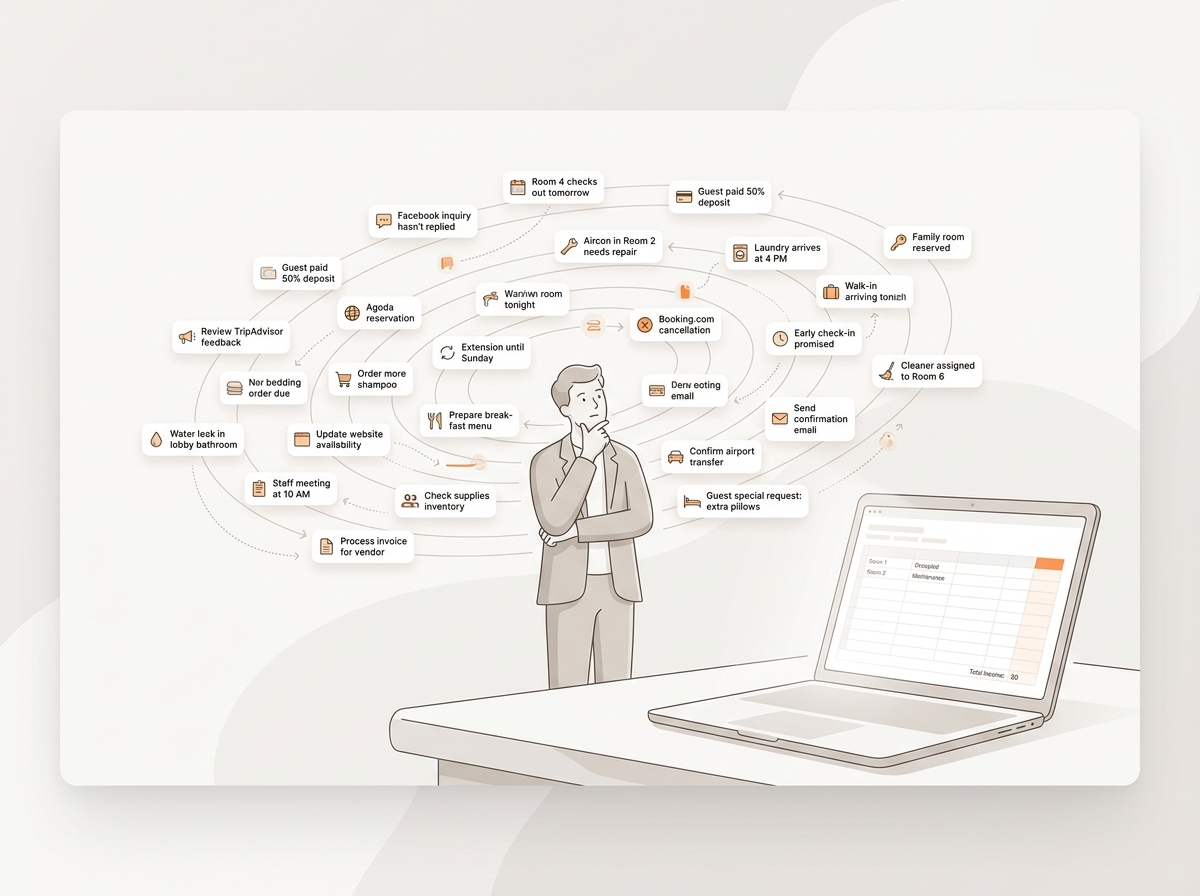
Think about what you're actually carrying around on a normal Tuesday. Room 5 checks out tomorrow, but you haven't written that down anywhere, you just know it. The Facebook inquiry from yesterday wanted the family room, not the one she asked about first. Room 3's aircon is still broken, so you're quietly steering walk-ins away from it without telling anyone why. The electrician is coming Friday, maybe. That guest from Cebu already paid half through GCash, you remember the reference number starting with 9. You promised someone an early check-in last week and you still haven't told the cleaner.
None of that is in the spreadsheet. All of it is in you.
And for a while, that works fine. A 6-room homestay run by one person doesn't need a system. It needs a person who remembers things, and you are that person. You built the place. Of course you remember everything about it.
But here's the part nobody warns you about. The better you get at remembering, the less anyone else needs to.
Your spouse doesn't write things down because you'll know. Your one staff member doesn't ask questions because you're usually around to answer them. Bookings come in through Messenger, a phone call, an OTA notification, a walk-in at the gate, and you sort it all out in your head because that's faster than explaining a system to someone else.
So the business grows. And so does the list of things only you know.
Here's a question worth sitting with for a moment.
What happens if you're sick for three days?
Not theoretically. Actually picture it. Someone else has to answer the Facebook page. Someone else has to decide which room a walk-in gets. Someone else has to remember that the guest checking out today already paid in full, and the one checking in tomorrow only paid a deposit and still owes the balance in cash.
Do they know any of that?
What happens if your spouse isn't around to ask?
What happens if your receptionist resigns next month and takes two years of "ask her, she knows" with her?
If the honest answer to any of those questions is some version of confusion, scrambling, or "we'll figure it out," then you don't actually have a system. You have a very good memory, attached to one person, and a spreadsheet that only makes sense because that person is around to interpret it.
That's the uncomfortable part. It's not that spreadsheets are bad tools. Plenty of well-run properties use one for years without issue. The danger isn't the spreadsheet itself. The danger is a spreadsheet that only one person can actually read.
A column that says "paid" doesn't tell you which guest paid in cash at the gate and which one sent a GCash transfer with a typo in the reference number. A blank row doesn't tell you that the blank room is blank because the guest extended their stay and you took the booking over a phone call you never wrote down. A cell that just says "OK" might mean "confirmed," or it might mean "confirmed, but only if they don't ask for an early check-in, because we already promised that slot to someone else."
You know what those cells mean. Nobody else does. That's not a spreadsheet problem. That's a memory problem wearing a spreadsheet's clothes.
This is the quiet trap that most small accommodation businesses fall into. Every successful small guesthouse eventually reaches a point where it isn't really running on a spreadsheet, or a calendar, or even a booking management habit. It's running on whoever happens to remember the most. And the owner is usually that person, which feels fine right up until the day it isn't, the day you're stuck at a hospital, or your one staff member quits without notice, or you simply want a weekend off without your phone buzzing every twenty minutes with a question only you can answer.
That's the real cost of running a property on memory. It's not that mistakes happen, although they do, a double-booked room here, a missed early check-in there. It's that the business has a single point of failure, and that point of failure is a human being who needs to sleep, get sick, and eventually take a day off.
A spreadsheet isn't dangerous.
A spreadsheet that only one person truly understands is.
This is really what people mean when they talk about needing better booking management or wanting actual property management software instead of a notebook. It's rarely about wanting prettier calendars or fancier dashboards. It's about wanting the knowledge currently stored inside one person's head to live somewhere everyone on the team can see, understand, and act on, whether that's a half-payment, a broken aircon, a promised early check-in, or a guest who's about to extend their stay.
That's really what a hotel management system is for, at a small scale. Not to replace the owner, and not to make the business feel more "corporate." Just to take the dozens of tiny details currently living in someone's memory and put them somewhere any staff member, or any future hire, can actually read and trust. The goal was never to get rid of spreadsheets. It was always to stop depending on memory to make them mean anything.
Because systems were never really about replacing people.
They're about making sure the business still works on the days the people who built it aren't around.
Free to start
Run your hotel without the headaches.
Try the live demo in 30 seconds. No signup needed.