OTA Rate vs Direct Rate: What Hotel Owners Actually Do
Should your Agoda and Booking.com price be higher than your direct rate? Five seasoned hotel owners share what they do, and we check each answer against how OTAs really work.

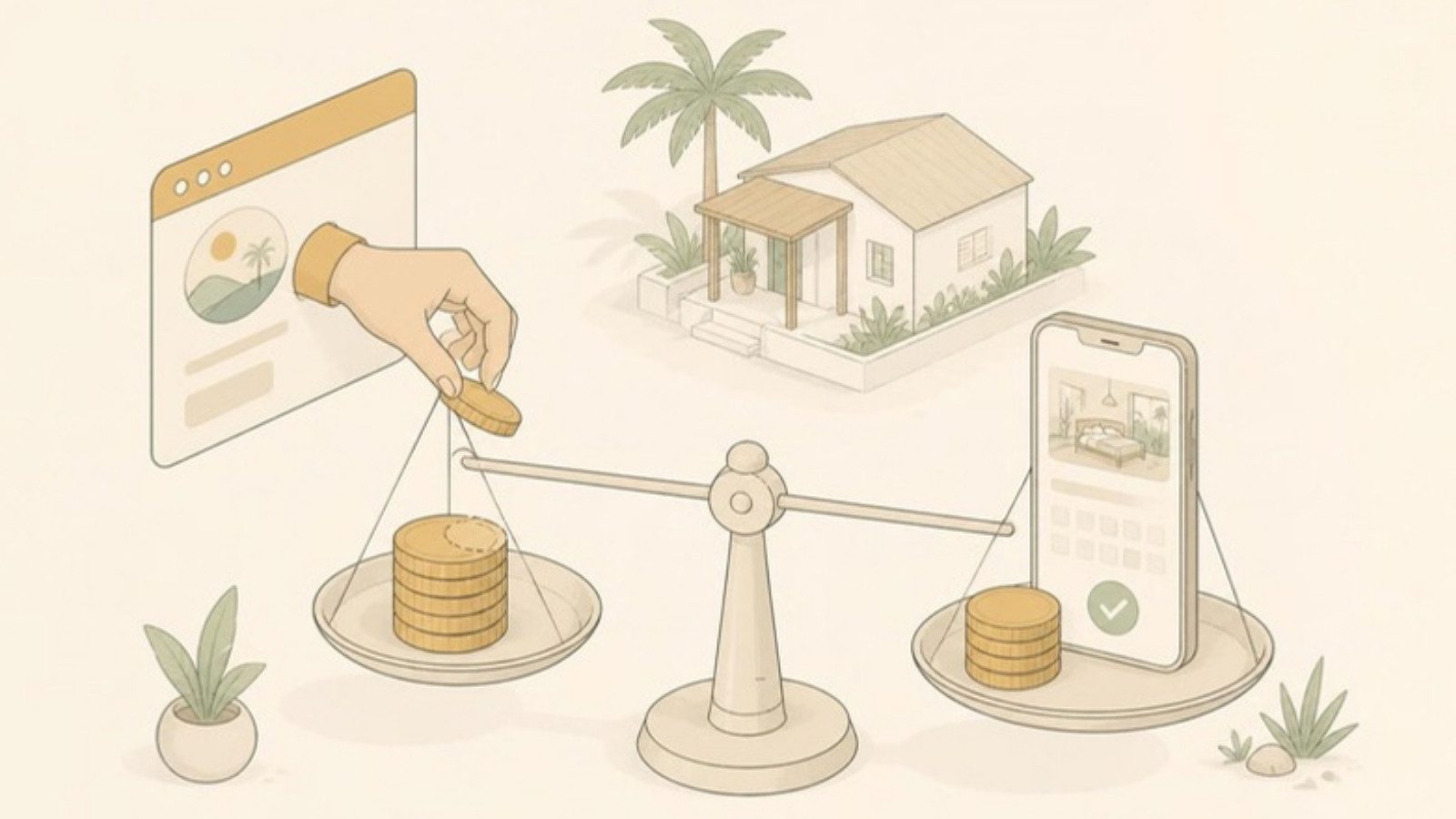
Most experienced hotel owners keep their OTA rate close to their direct rate. They treat the OTA commission as the cost of getting a new guest, not as money lost.
Every small property owner on Agoda, Booking.com or Airbnb runs into the same problem. The OTA takes about 15% of each booking. If you raise your OTA rate to cover it, guests book the cheaper place next door. If you don't, you earn less on every room.
So we asked five seasoned hotel owners what they actually do. Their answers don't agree, so we checked each one against how the OTAs really work. This post covers what they said, what holds up, and a simple plan for a small guesthouse in the Philippines.
What 5 hotel owners told us
Two owners keep direct cheaper, one keeps all rates the same, one matches OTA prices on request, and one says it depends.
| Owner | Direct vs OTA rate | How they do it | Their reason |
|---|---|---|---|
| 1 | Same on all online channels | Turns off OTA-collected payments and fenced discounts. Gives a small discount only on phone bookings | Commission is the cost of getting a guest. A cheaper direct rate means you pay a "commission" to your direct guests |
| 2 | Direct can match any OTA price | Price-matches any real OTA rate. Keeps light discounts for return guests and email sign-ups. Dropped OTAs that sold below their rate | Better to give a guest 20% off direct than pay 20% to an OTA |
| 3 | Direct 10 to 20% cheaper | Prices one OTA highest because it's the hardest to work with | That OTA costs more time, so it pays more |
| 4 | Direct 10 to 15% cheaper | Lower direct rate | Saves the guest money. But many repeat guests still book on the OTA |
| 5 | Depends | Looks at room quality, room count and cost per occupied room first | Not every property is built to compete on price |
What's right and what isn't
Owner 1 gives the strongest answer for a small property. Most of the other answers are partly right, but each one carries a risk.
| Claim | Verdict | Why |
|---|---|---|
| OTA commission is a cost to get a guest | Correct | You only pay it when the OTA brings you a guest. A direct booking has costs too: your time on chat, payment fees, no-shows |
| If you turn off OTA-collected payments, the OTA can't cut your price | Mostly correct | With Payments by Booking.com, Booking.com collects the money and can show a lower price than your rate. It pays the difference itself, so you still get your rate. But guests now see Booking.com as cheaper than you |
| Add 15% to the OTA rate to cover a 15% commission | Small error | The 15% is taken from the higher price. To keep the same money, you need to add about 17.6%. See the math below |
| A cheaper direct rate wins the guest | Partly correct | Owner 4 shows the limit. Many guests stay on the OTA for points, free cancellation and trust. Price alone doesn't move them |
| Drop OTAs that sell below your rate | Correct, but costly | It stops leakage. But for a small Philippine property, Agoda or Booking.com can be most of your bookings. Test before you drop one |
| Price one OTA higher because it's hard to use | Risky | It can be fair. But outside Europe, OTA contracts can still have rate parity rules. A higher rate can also push you down that OTA's rankings |
| Your strategy depends on your property | Correct | Know your cost per occupied room per night first. Then decide how much you can give away |
A note on rate parity: the law only changed in Europe. In the European Economic Area, Booking.com removed rate parity rules from its contracts in 2024. A Philippine property is outside the EEA, so read your own OTA contract.
The math for a ₱2,000 room
A 10% direct discount still earns you ₱100 more per night than the same room sold on an OTA at full price.
This example uses a 15% commission. Airbnb now charges most hosts a 15.5% host-only fee, and Booking.com and Agoda are often 15% or more. Use your own rate.
| How the guest books | Guest pays | Commission (15%) | You keep |
|---|---|---|---|
| Direct, full price | ₱2,000 | ₱0 | ₱2,000 |
| OTA, +17.6% markup | ₱2,353 | ₱353 | ₱2,000 |
| OTA, +15% markup | ₱2,300 | ₱345 | ₱1,955 |
| Direct, 10% off | ₱1,800 | ₱0 | ₱1,800 |
| OTA, same price as direct | ₱2,000 | ₱300 | ₱1,700 |
To keep the same money on an OTA, use this formula:
OTA rate = Direct rate ÷ (1 − commission)

Example: ₱2,000 ÷ 0.85 = ₱2,353
Remember that direct isn't free. You spend time on Messenger, you wait for GCash or bank transfer proof, and some guests don't show up. Count these costs before you set a big direct discount. We break them down in Direct Bookings vs OTA Bookings.
The hidden discounts that break your price
Your OTA price can drop below your direct price even when you didn't change it. This is the real problem behind the whole question.
- Booking.com-funded discounts. When Booking.com collects the payment, it can show the guest a lower price and cover the difference itself. You get your full rate, but your direct price now looks expensive
- Promotions you didn't choose. Some OTA programs and promotions are switched on by default. Check your extranet for active deals every month
- Wholesale leakage. A rate you give a tour operator or wholesaler can show up on other booking sites, cheaper than your own. In an Expedia Group study, hoteliers said they lost about 6% of revenue to this in a single year
Owners 1 and 2 both fight this. Owner 1 turns off the payment setting that lets the OTA cut the price. Owner 2 drops any OTA that sells below their rate.
A simple pricing plan for a small guesthouse
Keep one price on all OTAs, give direct guests a small reason to book direct, and check your listings every month.
- Find your floor. Work out your cost per occupied room per night. Never sell below it on any channel
- Keep all OTAs at the same price. That way no OTA looks cheaper than another. Update all of them at the same time
- Don't mark up more than you can win. If your OTA price is much higher than your neighbors', guests won't pick you. Only mark up if you have few competitors in your area
- Give direct guests a small perk. A 5 to 10% discount, free breakfast or late checkout. A perk keeps your public price the same and still rewards direct guests
- Target return guests. Most new guests find you on an OTA. At checkout, tell them how to book direct next time. Add your Messenger or booking link to the receipt
- Check your own listing as a guest. Once a month, search for your property on each OTA. If the price is lower than your rate, find the promotion or setting and turn it off
- Review your OTA contract. Look for rate parity rules before you set a different price on one OTA
Where a channel manager helps
Step 2 is hard to do by hand. When you change a price on Agoda, you also have to change it on Booking.com and Airbnb. Forget one, and that OTA becomes the cheapest place to book you.
A channel manager sends one price and one calendar to all your OTAs at the same time. Go Overbooked is a channel manager built for small Philippine properties. You pay in pesos by GCash or bank transfer, and we help you set it up over Messenger.
OTA rate vs direct rate FAQ
Should my Agoda price be higher than my direct price?
Only a little, or not at all. A big markup makes you look expensive next to nearby properties. Most owners keep OTA prices equal and give direct guests a small perk.
How much should I add to cover a 15% commission?
About 17.6%. Divide your direct rate by 0.85. Adding only 15% leaves you a little short.
Why does Booking.com show a lower price than the rate I set?
If Booking.com collects the payment, it can fund a discount out of its own commission. You still get your rate. Check your payment settings and active promotions.
Is rate parity still required in the Philippines?
The 2024 ban on parity rules applies in the European Economic Area. For a Philippine property, check the terms in your own OTA contract.
Why do guests still book on the OTA when direct is cheaper?
OTAs give points, free cancellation and a feeling of safety. Give guests a clear, easy way to book direct, and focus on return guests first.
Sources
Free to start
Run your hotel without the headaches.
Try the live demo in 30 seconds. No signup needed.